Repositioning: Why the B2B brand Riegler now relies on emotions

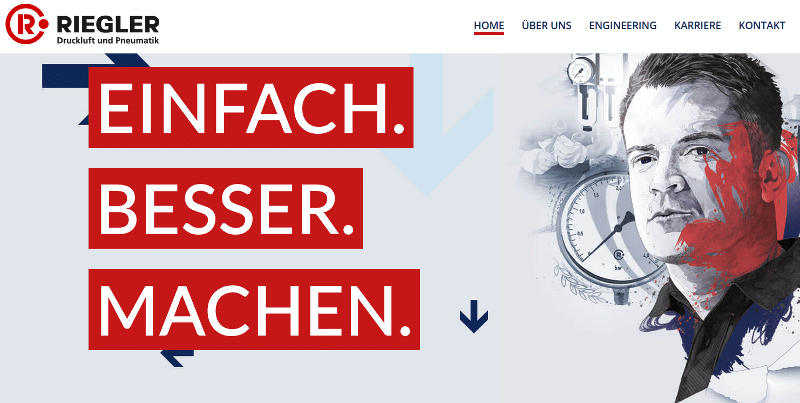
Realigning a brand in the business-to-business environment is a demanding challenge. The rebranding of a B2B brand was the focus of a lecture by Philipp Wacker (photo), managing director of the company Riegler & Co KG in Bad Urach. The industry: compressed air and pneumatics. Using the practical example of the reorientation of his brand, he provided insights into its B2B marketing concept at the Private University of Göttingen (PFH).
The PFH graduate appeared at the invitation of Dr. Hans-Christian Riekhof, Professor of International Marketing. In an interview with Riekhof, Wacker explains the background to the repositioning of his brand.
Professor Riekhof: You have carried out a complete repositioning of the Riegler brand for the company. What was the trigger for this decision?
Philipp Wacker: There were three factors that played a major role. Firstly, the RIEGLER brand was not clearly described due to historical reasons. There were different perceptions of who RIEGLER is or what RIEGLER stands for, partly internally, but especially towards our business partners. Secondly, we worked with image worlds from five different generations, which simply no longer fit together visually. And last but not least, we are in a strongly commodity-dominated market with our industry, technical trade. Rational services dominate and there is price competition, i.e. displacement competition.
Riekhof: How do you convince the entire management team, including the shareholders, that a repositioning was necessary?
Wacker: We have been aware for some time that we need to do something. I think that as a new generation I was certainly the key factor in finally implementing this step. However, the management team was fully integrated into the project team and was involved in many workshops. They were able to accompany from the beginning, bring in their own impulses and steer in certain directions. We also regularly presented the processes at the shareholders’ meetings and met with great approval. The concept is supported by all limited partners.
Riekhof: Is there a business case for the repositioning, i.e. do you expect the effort to pay off in the foreseeable future?
Wacker: The repositioning is primarily a strategic measure to position the brand for the future. We position ourselves as solution finders for our customers and adapt the touchpoints of the relevant customer journeys accordingly to a newly developed performance promise. Therefore, one should be able to expect a measurable ROI, but it is difficult to predict when this will occur.
We wanted emotions like adventure, fantasy and enjoyment
Riekhof: How did you manage to make it clear that it is also useful and necessary in the B2B field to emphasize the emotional dimension in communication?
Wacker: In various analyses, we found that the communication of most providers on the market is very strongly characterized by classic messages. Most have been “around forever”, are “powerful”, “reliable” and offer an “excellent service”. At the product level, “product lego” is often played, the much more interesting usage representations are missing. With such an interchangeable or even boring type of communication, I no longer convince anyone today, especially not in times of digitization. We see it as an opportunity to counteract these rational factors of discipline and control with emotions such as adventure, fantasy or enjoyment and thus give a brand a little more freshness and sexiness.
We will therefore focus more on awareness and sympathy in the future. We want to communicate more “courage”, “doing”, “shaking up” and also “power”. We also have a kind of buddy status with many customers due to historical reasons. We want to get rid of that. We want to be more of a creator and solution finder for the customer.
Riekhof: In the repositioning of the Riegler brand, you relied on the support of an agency. What criteria were particularly important to you in the agency selection?
Wacker: It was important to us that the agency has competence in the area of brand development. We had some pitches and chose an agency from Stuttgart. This agency also focused on brand development with emotional added value. That fit quite well with us.
Riekhof: What was the main reason for using personas in the repositioning project?
Wacker: The PERSONA model allows us to address our target groups more precisely. For example, we supply classic technical dealers as well as OEMs. Both target groups have different content requirements in direct communication. With an OEM, I usually speak to an engineer, with a dealer to a classic buyer. We want to move away from schema F towards needs-based communication. So away from “what do WE want to say” to “what INTERESTS the different types”. That’s why the PERSONA model was an essential component already in the brand finding phase.
Riekhof: How did the core idea “From makers for makers” come about?
Wacker: We thought about where we want to position ourselves as a brand or which credible, relevant and differentiating field is still left for us that is still unoccupied in the market. And where is the trend of differentiation going if I can no longer score with rational services like product availability and ordered today/delivered tomorrow. And that is the service idea. Here we are stronger than other providers. We offer our customers a multi-channel concept which includes, for example, travel with our field staff, engineering services, personalized advertising material, excellent master data quality or personalized web shops. This service idea and the corresponding consistent orientation towards clear recognition and implementation of customer needs have led us to launch the maker concept.
Furthermore, we say that we actively and jointly tackle the challenges of today’s time with our customers. Just “from makers for makers”.
Riekhof: Can you describe the tonality that underlies the new positioning?
Wacker: The tonality of a “maker” is correspondingly different, just emotional. We want to send consistently positive messages to the customer, which are somewhat provocative but formulated in a very sympathetic way. Since, as mentioned, customer orientation and the service idea are the focus of communication, we express ourselves very goal-oriented (“Being able to do is one thing, being able to do is another”) and inspiring (“If we only delivered parts, we would have become postmen”). Of course, a maker is always activating and surprising.
Riekhof: In communication, you do not rely on models, but have used your own employees for the photo shoot. What were the motives, and how did the employees react?
Wacker: The makers are ourselves, every single employee of us. That’s why we refrained from external photo models and integrated the makers, that is ourselves, into the communication. The employees were extremely well received, such an action is absolutely appreciative and motivating.
Riekhof: As part of the implementation of the new positioning, you have also created a new range architecture. What were the objectives, and can you already see initial effects?
Wacker: We also want to adapt our range structure to the new performance promise. So we asked ourselves how we can prove customer understanding, our maker tradition and added value qualities by ensuring that all RIEGLER customers “always and easily find the right products”. Based on the requirements of our PERSONAS, we then developed a class model that is supposed to sort or structure the range according to various criteria. Here it is about a range guidance system or quality or individual gradations. In short, the range should convey orientation, simplicity and trust. I can’t say more about this at the moment, we will only appear on the market next year.
Riekhof: Is Amazon a threat to the Riegler business model in the medium term?
Wacker: No, I don’t think so. I see the digital development of B2B trade for RIEGLER rather as an opportunity. Pure players like Amazon, Contorion or Conrad rely on strong brands. With our positioning, we make ourselves extremely attractive to this customer group. If you look at the new image of RIEGLER, you are certainly approaching a standard that established brands in this area already offer. On the other hand, we are strong in e-business service. We offer excellent master data quality and already process over 50% of our orders electronically. Our PERSONA from the e-commerce area would say “If the content fits …”. I think that hits the nail on the head.
Riekhof: Mr. Wacker, thank you for this interview.


