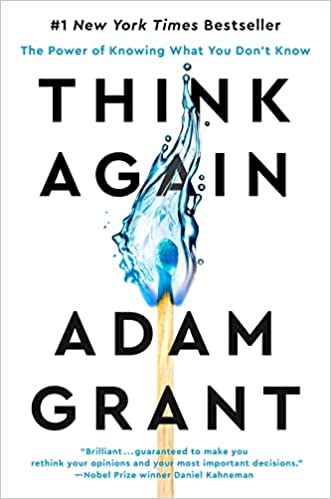
Book Recommendation No. 50 (2022): ADAM GRANT: THINK AGAIN. THE POWER OF KNOWING WHAT YOU DON’T KNOW.
London 2021
By Hans-Christian Riekhof
“Think again” – is that a book title that you immediately grab? Do you immediately have the right associations? Or is it the hint on the cover that it is a No. 1 New York Times bestseller? Hard to say.
In any case, the by no means new idea is at the center that scientific thinking, the search for errors, the effort to refute hypotheses, is far superior to other forms of thinking. A thought that I emphasize again and again in my seminars and lectures. Is it worth reading a book that is dedicated to this topic in all depth and breadth from various perspectives?
The answer is clearly “yes”. Adam Grant shows how we ourselves tend to ignore our own mistakes. He presents psychological research results, according to which our own mistakes (for example as stereotypes) are more likely and pronounced,
– the higher our IQ is
– the better our mathematical knowledge and skills are
– the more we desire certain things.
We learn what the Dunning-Kruger effect is: often we have great confidence in our own knowledge when we are quite incompetent in a subject area: “The first rule of the Dunning-Kruger club is you don’t know you’re a member of the Dunning-Kruger club”, so David Dunning. These are the comments of the football fans from the stand (or from the sofa in front of the TV), who of course would have had the better concept for the team lineup.
Adam Grant’s recommendation: one should admit that one does not really know much. It is better to welcome information that contradicts one’s own views – which is not so easy. So in chapter 3 it is also about “The joy of being wrong”. Adam Grant shows how to build a critical distance to one’s own beliefs and how important it is to regularly and systematically question one’s own beliefs. Our natural striving for cognitive consistency is put to the test.
He describes the techniques with which a few experts correctly predicted Trump’s election victory and Brexit, thus refuting socio-demographic forecasts. Grant explains how to deal with conflicts in groups in the sense of different interpretations and perspectives so that valuable work results can be achieved.
His considerations can also be applied to negotiation strategies: how many arguments should one present if one wants to be successful, why should one “sort out” the weakest arguments in any case, why should one pick up arguments of the opponent benevolently, why is it useful to admit doubts about one’s own beliefs?
The chapter on how to conduct “motivational interviews” is also highly exciting, i.e. how to get the other person to question his own strong beliefs: how can you get convinced vaccine opponents – a truly highly emotional and controversial topic! – to get vaccinated? How can an African American motivate a fellow citizen to give up his membership in the Ku Klux Klan?
The considerations in chapter 8, where it is about “Depolarizing Our Divided Discussion”, are also impressive. The currently much-discussed “division of society” is ultimately also a question of how we deal with our beliefs, whether we rely on polarizing black-and-white arguments or on differentiating perspectives.
The title “Think again” needs explanation. But the book by Adam Grant is extremely worth reading, even if you have always been convinced that good hypotheses advance your knowledge process.