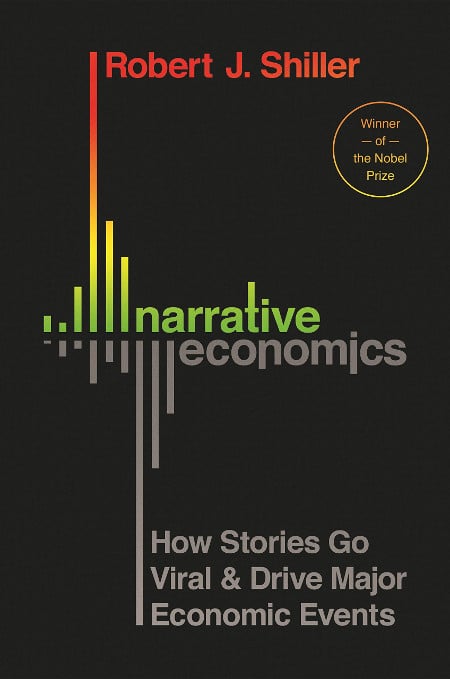
Book Tip No. 40 (2019): NARRATIVE ECONOMICS. HOW STORIES GO VIRAL AND DRIVE MAJOR ECONOMIC EVENTS.
Princeton 2019.
For some time now, it has been observed that stories play an important role in marketing. Therefore, storytelling has become a new discipline in marketing. Under the heading Content Marketing (see also our empirical study Riekhof/Jacobi) the communicative confrontation with the customer about content is now given a wider space.
If an economist and Nobel laureate like Robert Shiller now turns to the subject area of Narrative Economics, one can be curious. Shiller examines how narratives such as “Great Depression”, “Bitcoins”, “technology-induced unemployment”, “gold standard”, “American Dream” or “Artificial Intelligence” have very real effects on economic behavior. Shiller is particularly concerned that obviously false narratives can have devastating real consequences. He looks at the Great Depression in detail and sees a major influence of the narratives on the actual economic development.
Stories influence real market behavior
This is of course revolutionary: stories influence real market behavior – not just supply and demand. This is a ultimately necessary extension of economic explanatory patterns that Shiller offers. It is made possible, among other things, because there are corresponding digital search options that record or trace the spread of the narratives in the media.
There is the portal ProQuest News & Newspapers and the Google function Ngram, which Shiller uses for analysis purposes. This is a new analytical dimension, even if it remains difficult to derive strict causalities from the data.
Narrative Economics therefore represents a new orientation of economic theory. However, we are only at the beginning. Shiller goes into detail on many historical narratives. For some more recent narratives, one would have wished for a detailed examination, such as the narratives of the “end of growth”, the “overpopulation of the earth”, the “end of work”, the “end of property”, “system-relevant banks” or “shadow banks”.
Perhaps the ideas of Narrative Economics will fall on fertile ground in economics, and we will get comprehensive analyses of the narratives just mentioned. It could prove very helpful if it is possible in this way to debunk myths.
01.12.2019
Dr. Hans-Christian Riekhof
