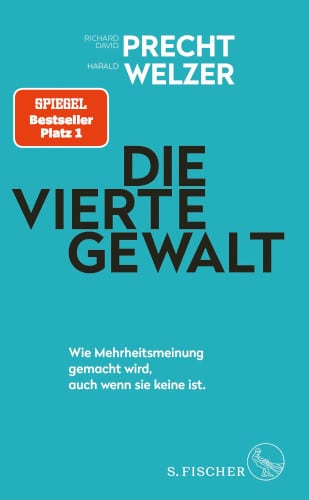
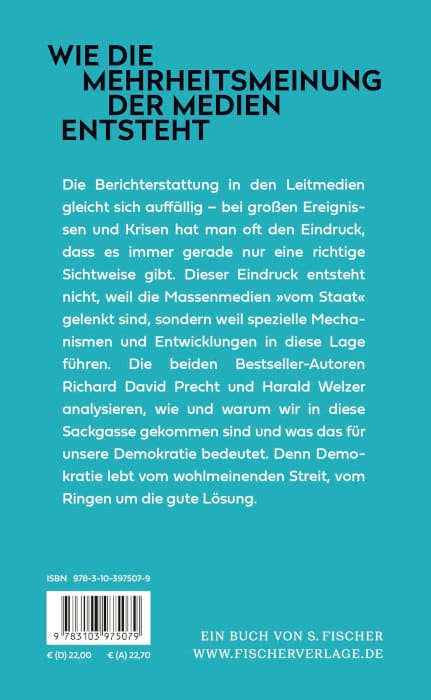
Book Tip No. 61 (2023): RICHARD DAVID PRECHT / HARALD WELZER: THE FOURTH POWER. HOW MAJORITY OPINION IS MADE, EVEN IF IT IS NOT.
3rd edition Frankfurt 2022.
By Hans-Christian Riekhof
I admit it: some books have a hard time attracting my full attention. In this case, it’s not the topic: the fourth power in the state – the media – is an extremely exciting and highly relevant field for me. Just think of the influence of the (classical as well as digital) media on the processes of political will formation, for example in the case of Brexit or the election of Trump as President of the USA. This book had a hard time for another reason: I have not yet found the right access to the philosophical discourses of an R.D. Precht.
The loss of trust of citizens in the media
But this book quickly captivated me. Let’s let the authors speak directly: “As well documented by scientists, the influence of the media on politics has continuously, even enormously, increased over the last three decades, but paid with the aforementioned price: the dramatic loss of trust of citizens in published opinion.” (p. 9). This succinctly sums up the program and concern of the book.
A second passage: “Whoever exerts media ‘pressure on the chancellor’ determines events in this way. And the question is: with what right? The Fourth Power has no constitutional rank, its co-governance is not intended.” (p.37)
Talk show hosts look for dissent
Let’s let the authors speak directly again: “Four or five different talk shows alone in the first two programs of the public broadcasters have to be filled with controversial topics every week; where is so much dissent supposed to come from in a mediocracy trimmed for smartness? And the fewer edges and corners the political class shows today, the more wedges have to be driven somewhere, alleged frictions made public and polarizations claimed” (p. 122 f.).
Perhaps you have become curious to deal with the Fourth Power and its changed role and above all mode of operation. The authors provide sufficiently well-researched material, and they come to understandable evaluations and assessments.
Journalists should look for solutions instead of discussing problems
The authors demand a further development of journalism: a problem-oriented journalism is no longer enough for them, they demand the further development to a solution-oriented journalism (p. 254). This ultimately means taking a position on different solution concepts to the major problems of our time and evaluating them. Simply querying the evaluation of politicians of different colors is not enough in their estimation.
Precht and Welzer also suggest that journalists spend more energy on self-reflection than before (p. 257). Very thoughtful suggestions for the further development of a stable democratic system.
If a new edition of the book should become necessary (which I wish for the authors), then two aspects deserve much more attention: first, the completely unbalanced ratio of opinion and facts in media reporting (I sometimes speak of “fact-free opinion journalism” …). Pay attention to it: how many opinions does a report contain, and how much valuable, independently researched background information?
And secondly, the handling of numbers, comparisons, quantifications in the media: we need a significantly higher quality in the quantitative classification of events and their effects. So let’s hope for an extended new edition.

