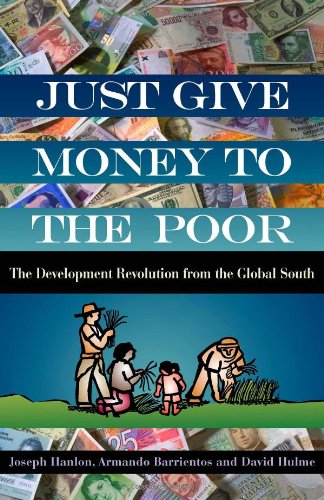
Book Tip No. 55 (2022): JOSEPH HANLON / ARMANDO BARRIENTOS / DAVID HULME: JUST GIVE THE MONEY TO THE POOR. THE DEVELOPMENT REVOLUTION FROM THE GLOBAL SOUTH.
Boulder/Cal. 2013
By Hans-Christian Riekhof
Some books only fall into my hands with a certain delay, like this one. It is therefore no less current, rather the opposite. And Nassim Nicholas Taleb has already pointed out to us that you should actually not buy any newly published books at all, because you do not know whether they will be accepted, whether they are good in terms of content and whether they will ever make it to a second edition.
Hanlon and his co-authors report on a largely unnoticed trend and a silent revolution in the fight against poverty in the global south. The core idea is initially perhaps surprising, but very plausible on second thought: Poor population groups are characterized by the fact that they have no money. You have to think about that for a moment.
Hanlon/Barrientos/Hulme: a regular and reliable amount of money for poor social groups
Not to support these social groups with education, microcredits, medicines or other free health prevention measures, but to provide them with a (not particularly large) amount of money on a regular and reliable basis, is at the center of numerous programs in poverty-stricken countries.
Hanlon et al. describe these programs, which are very differently designed in detail, and their remarkable successes. The measurable effects include demonstrably better nutrition of those affected, lower child mortality, better health constitution and more regular school attendance of the affected children.
Regular payments with positive effects on school attendance, health and work
Of course, there are questions that require further research, such as how targeting can be designed, i.e. according to which criteria the eligible families are selected. Some programs set conditions for regular payments (such as participation in health prevention programs or school attendance of children) – these are so-called CCT programs (Conditional Cash Transfer).
But there are indeed indications that unconditional payments have very positive effects on school attendance, health and also employment. These payments do not lead to the affected people sitting back and doing nothing. They simply have more time, more energy and more money to solve everyday problems.
Unconditional basic income for poor population groups
One thing seems pretty clear: these payments – essentially an unconditional basic income for the really poor population groups – do not lead to the affected people no longer working. And the authors point out another side effect: you no longer need expensive development programs and development workers with off-road vehicles to organize these cash transfers.
Hans-Christian Riekhof