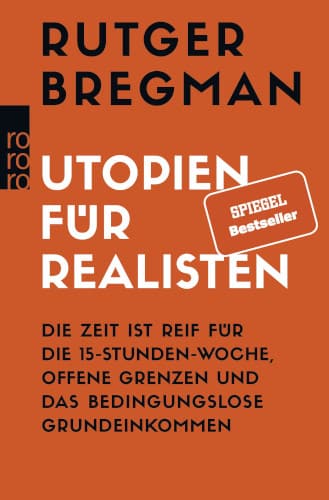
Book Tip No. 54 (2022): RUTGER BREGMANN: UTOPIAS FOR REALISTS
18th edition Hamburg 2021.
By Hans-Christian Riekhof
We are surrounded by media that confront us with the disasters of this world in an enormous intensity, be it through the press, television or digital media. We learn about more or less insignificant dramatic events that take place far away from our homeland or our place of residence. And we are all too receptive to such disaster scenarios.
This creates a more or less unrealistic (not to say: false) perception of the state of our world; authors like Gregg Easterbrock (see Book Tip No. 37) or Hans Rosling (see Book Tip No. 29) have repeatedly pointed out. Björn Lomborg would also be worth mentioning here.
What we lack, however, are comprehensive ideas about a better world. This is one of the core messages of Rutger Bregman: we need new utopias, especially since some utopian social models – think of socialism – have now failed in reality.
Utopias ultimately reveal a lot about the time in which they were created and the prevailing situations of scarcity. The medieval vision of the land of plenty shows that hunger, diseases, pandemics and other physical sufferings dominated everyday life; today, the land of plenty of the Middle Ages has lost much of its utopian character.
Bregmann urgently calls for thinking much more intensively about utopias and developing utopias. His concrete wishes for the future revolve around three core ideas: the reduction of work and the 15-hour week, open borders and freedom of movement for all, and an unconditional basic income.
Bregman argues that these ideas have real chances of being realized. And he refers, for example, to very exciting – and today not widely known – empirical research results from the global South, in which unconditional money transfers (“Give money to the poor”) represent a very successful alternative to traditional development aid projects. The core idea: what the poor of this world lack is money. You have to think about this sentence for a moment to see its implications.
Rutger Bregman also makes a very interesting distinction between societal activities that generate wealth and those that only redistribute or shift wealth. A very remarkable distinction: High-frequency traders on the stock exchanges are paid extremely well, but they only redistribute wealth. They may even contribute to the gross national product in mathematical terms; we have defined interesting methods for measuring the GNP.
We should apply the criterion “generate wealth” vs. “redistribute wealth” much more often in public debate in order to distinguish between meaningful – because value-creating – and less meaningful activities that only redistribute value; a distinction that is also found in a similar form in Mariana Mazzucato (Book Tip No. 48) when she writes about the role of the state in steering innovation.
Let’s just hope that you, dear reader, pursue your professional activity in a societal value-creating area, rather than just redistributing values.
