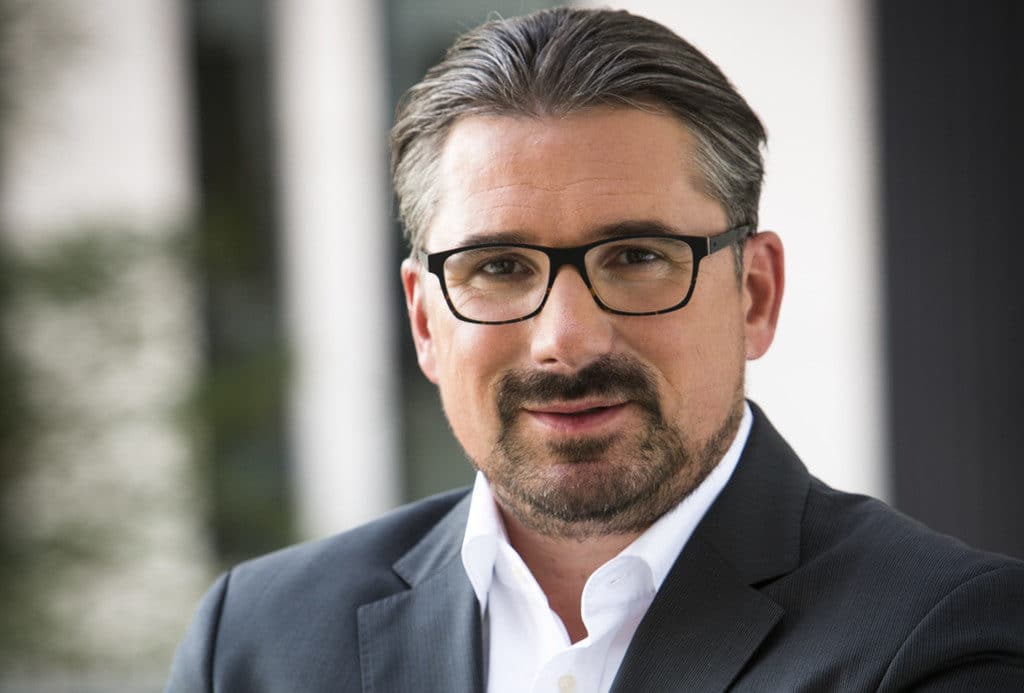
Interview with Markus Reischl from Salesforce Germany by Professor Riekhof
Markus Reischl is one of the speakers at the 6th Göttingen Marketing Day on November 11, 2016. Professor Riekhof conducted an interview with Markus Reischl, Regional Vice President Alliances & Channels EMEA Central Salesforce Germany, in advance.
Prof. Riekhof: Brands and marketing traditionally play a lesser role in B2B business than in B2C business. If you compare yourself with your direct competitors: is marketing and branding more important at Salesforce?
Markus Reischl: Absolutely. Although Salesforce is the market leader for cloud-based CRM solutions, we have to establish “Salesforce Germany” as a brand in Germany. That was also the reason why we moved our WorldTour in Germany from Munich to Hanover to CeBIT. We design individual customer journeys for our customers across all digital channels such as email, mobile & social media…or also via Pardot for B2B marketing automation/mailings…
Prof. Riekhof: What does the Salesforce brand stand for?
Markus Reischl: Salesforce stands for “Customer Success & Customer Centricity”. Salesforce also stands for a unique business & technology model. Thanks to multitenancy, all Salesforce customers are always up to date thanks to a common infrastructure and automatically receive three releases per year. With the metadata platform, we have an easily adaptable and scalable platform, with the adjustments remaining even after an update. Salesforce also stands for an open ecosystem with a wide range of partner applications that are available to our customers via the world’s leading marketplace “App Exchange”. In addition, Salesforce stands for “Giving Back” with our philanthropy model 1- 1 -1. 1% of employee time, 1% of equity, 1% of our products for charitable purposes.
Prof. Riekhof: If you were to describe the principles and strategic orientation of marketing at Salesforce: what do you place particular emphasis on, what is at the center of marketing activities?
Markus Reischl: The customer is always at the center and what the customer has achieved with Salesforce: higher sales productivity, better response times in service etc. If you go to a Salesforce event today, Salesforce communicates the possibilities of the solution or various clouds (Sales/ Service/ Marketing/Community/Analytics/App Dev/IoT) via concrete “Customer Success Stories”.
Prof. Riekhof: Salesforce is growing internationally by about $1.5 billion per year, which is enormous growth that is unparalleled. What are the success factors that generate this growth for you?
Markus Reischl: “Customer Success”. If we let our existing customers report on their successes, we get potential customers excited. Salesforce as a “brand” lives and grows with and through satisfied customers.
Prof. Riekhof: Such high growth must first be managed by an organization. Are there strategies for internal marketing to integrate the newly added employees (number?) each year and explain to them what Salesforce stands for?
Markus Reischl: Onboarding at Salesforce is a process perfected down to the last detail. Every employee goes on a 1-week boot camp and prepares for two to three weeks in advance via video studies and must also pass corresponding “badges” before the boot camp to be admitted. In addition to all the content, the company culture “Ohana” is in the foreground. Thus, every employee flies to the Salesforce headquarters in the USA for the boot camp to experience the company culture on site and to carry it back into the regions.
Prof. Riekhof: Salesforce relies on cloud computing. Customers entrust you with their very sensitive CRM data. Salesforce even works for companies that are in direct competition with each other. How do you manage to get customers to trust Salesforce so much?
Markus Reischl: TRUST is our #1 value. https://trust.salesforce.com
Prof. Riekhof: Salesforce consistently relies heavily on digital channels in customer communication. Can you give us examples of how you make Salesforce digitally tangible for your customers?
Markus Reischl: So, first of all, we ban every Customer Success Story on video, and these videos can be accessed by our customers via YouTube. Here are some examples:
Coca Cola: https://www.youtube.com/watch?v=xAYS8C3g_k4
Bugatti: https://www.youtube.com/watch?v=rGPCPGefPSE
Dreamforce: https://www.youtube.com/watch?v=TRS1y4_zNug
In addition, Salesforce relies on the Community Cloud to network certain user groups accordingly and to integrate them into a communication flow, such as for the Customer Community: https://success.salesforce.com
The Partner Community: https://partners.salesforce.com
The Marketing Cloud for individual customer approach (1-1 Customer Journeys) is essential for our direct approach.
To name just a few examples: https://www.salesforce.com/marketing-cloud/overview/
Prof. Riekhof: During our visit to the Salesforce headquarters during our Silicon Valley excursion of the PFH Göttingen, we learned that Salesforce sees itself as a premium provider that also realizes premium prices. What is the most important argument with which you justify premium prices to your customers?
Markus Reischl: Customer Success!
Prof. Riekhof: Thank you very much for the interview.
Leave a Reply
Want to join the discussion?Feel free to contribute!