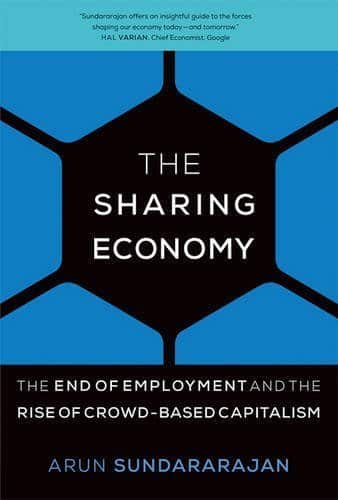
Book Tip No. 21 (2017): The Sharing Economy: The End of Employment and the Rise of Crowd-Based Capitalism
Cambrigde 2016.
The Sharing Economy has arrived in our everyday life: we use AirBnB, Car2Go, DriveNow and BlaBlaCar, and if the opportunity arises also Uber. How the business model of these and many other sharing platforms work, which are far less known, is reported by Arun Sundararajan. We learn, with the help of which mechanisms and processes the necessary trust for peer to peer interactions is built and also which role idealism plays in parts of the Sharing Economy.
The decisive thing about Sundararajan’s considerations is something else: the macroeconomic consequences that a peer to peer economy entails. Hierarchical structures of international corporations lose their importance through the new digital coordination mechanisms. Sharing platforms replace hierarchies and complement traditional markets. Labor markets are radically reorganized via platforms like Task Rabbit, production processes are decentralized and coordinated via platforms, the Wisdom of Crowds effect improves collective innovation processes, the exchange of goods on peer to peer platforms replaces parts of traditional trade. Thus, the Sharing Economy is much more than a new business model. Sundararajan shows knowledgeable and with a good eye for details, which far-reaching changes we have to adjust to. HCR