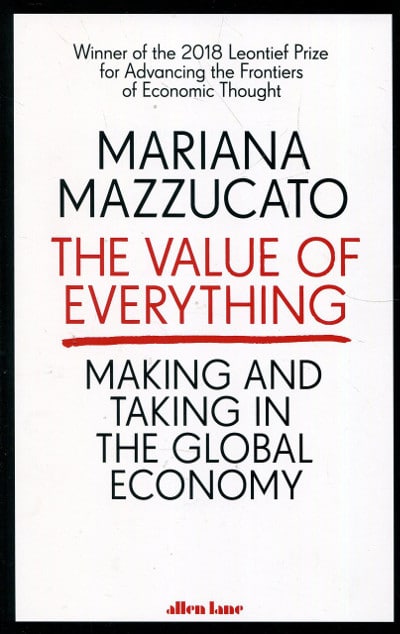
Book Tip No. 35 (2019): MARIANA MAZZUCATO: THE VALUE OF EVERYTHING. MAKING AND TAKING IN THE GLOBAL ECONOMY.
New York 2018.
When Mariana Mazzucato publishes a new book, at least my expectations are very high. Her work “The Capital of the State: A Different Story of Innovation and Growth” has helped to counter some misconceptions about the (ultimately quite significant!) role of the state in the innovation process and to debunk some myths that have formed around innovators, especially in the digital business. Who is aware of the high proportion of public funding with which Apple has co-financed its research?
Mazzucato turns to the highly exciting and also explosive topic of how and by whom value is created in an economy. This is an enormously important question, although it is not researched with high priority by economists. Unfortunately, the reader must follow her deep into the history of classical and later also neoclassical national economics: what do Ricardo, Marx, Quesnay and Adam Smith say on this topic?
We already knew that the gross national product represents the value of economic performance quite incompletely, if not even incorrectly. The suspicion that some players in the financial markets only make a limited contribution to the value creation of an economy and that very large sums of value were destroyed in the financial markets: not a surprising statement. That value is skimmed off rather than generated in monopoly-like situations in the Digital Economy, we can also already take from the press. That, on the other hand, the public sector can, according to Mazzucato, also develop value-creating activities, cannot be emphasized often enough.
So what remains? Mazzucato wants to initiate a debate about the (positive) value of economic action as well as about value-destroying activities. It is very much to be hoped that she will succeed. But what I miss is the attempt to provide a comprehensible and verifiable criterion for when we can speak of (positive) value creation from a neutral societal perspective.
12.3.2019
Hans-Christian Riekhof
