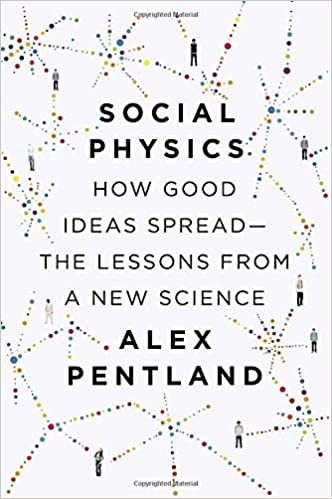
Book Tip No. 42 (2020): ALEX PENTLAND: SOCIAL PHYSICS. HOW GOOD IDEAS SPREAD – THE LESSONS FROM A NEW SCIENCE.
New York 2014.
A book review by Hans-Christian Riekhof
What does the Corona crisis have to do with Big Data and Social Physics?
Recognizing the spread patterns of Corona
Some books have been read for a while and quoted many times in lectures without me having mentioned and commented on them here. I have to admit: in the case of Social Physics, this is a mistake. The worldwide Corona crisis reminded me of Alex Pentland: you hear in the media about the first tentative attempts to reconstruct or even measure the spread patterns of the Corona virus in the population from mobile phone data, or to measure whether restrictions on freedom of movement are being observed. One gets the impression that evidence-based medicine should actually look different.
Social Physics as a new science
Very late, the experts in the health sector are coming up with ideas that Alex Pentland and his team have been actively researching for years. Pentland is considered a (co-) founder of a new science, which he calls Social Physics. This refers to the study of human social behavior using physical (mostly digital) data.
Big Data for the analysis of spread patterns
In times of Big Data, Pentland and his team use very different data sources to derive behaviors and interaction patterns from them in anonymized form. These include public transport traffic data, data from motor vehicles, car sharing and bike sharing data, mobile phone data, Google Search data, social media data, banking data, weather data, data from cameras in public places or credit card data. It is never the individual data set that plays a role, but the analysis and combination of large amounts of data that allow conclusions to be drawn without reference to the individual.
From a social research perspective, this is a groundbreaking new approach, as it involves measuring many variables per individual, and doing so over a long period of time: a long-term study with the research depth of cross-sectional studies.
Flu waves and the interaction patterns in cities
In a separate chapter, Pentland turns to the “sensing cities”. In particular, the mobile phone can provide data on how social phenomena such as interaction patterns in cities develop. For example, mobile phone data can be used to predict how flu waves spread in cities. The total number of phone calls and especially the calls after work increase sharply in the early phase of the spread, only to decrease very clearly in the actual phase of the disease.
Free data access for scientists and journalists
Unfortunately, nothing is read in the media today about such analyses of Corona. But Pentland also gives us an explanation for this: today these data belong to private corporations and are therefore not available for research (see the explanations on p. 178 ff). These data do not necessarily have to belong to the corporations, they could also be a public good that is available to journalists and scientists for analysis. Perhaps the Corona crisis is the occasion to start a public debate about the ownership and rights of disposal of data. It would be urgently needed.

