Maik Richter, Managing Director of the agency Heimat Berlin, in conversation with Professor Riekhof
As part of the 6th Göttingen Marketing Day on November 11, 2016, Maik Richter from the Heimat agency will talk about the success of the Hornbach campaigns. In advance, Professor Riekhof conducted an interview with Maik Richter.
Prof. Riekhof: Hornbach is the hardware store with the cheekiest and at the same time most attention-grabbing advertising compared to its direct competitors. What do you attribute this to?
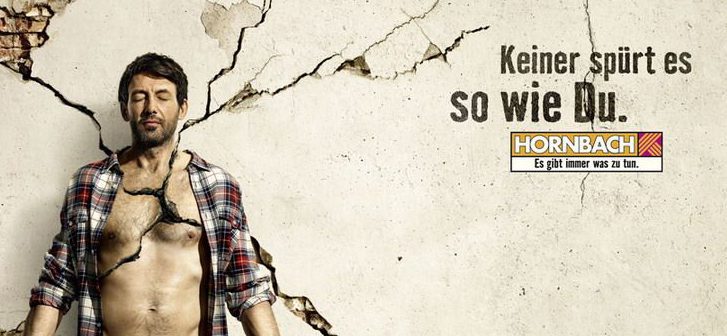
Maik Richter: The courage and intelligence of all those involved. And having decided to do it differently than everyone else. And to move away from a product-, price- and offer-driven communication and to go their own way. Hornbach has been doing this for over 15 years. We don’t always have to be the cheekiest – and we’re not always – but those who understand the DIY enthusiast and his needs best. The DIY enthusiasts feel this. They find themselves and a “brother in spirit” at Hornbach. From the very beginning, we have been concerned with understanding what drives hardware store customers, DIY enthusiasts and makers. And then implemented it in communication in such a way that Hornbach is also understood by its (potential) customers, is recognized as “one of us”. In a way that of course first has to get attention in order to be heard at all. The presentation is spectacular, the core and thus the messages of the Hornbach advertising are always relevant for their recipients.
Prof. Riekhof: What does Hornbach advertising convey? What is Hornbach’s long-term positioning? Is there a risk that each campaign sends a new message, so that the brand core is not visible enough?
Maik Richter: Hornbach stands for “passion for projects”. And is thus the aforementioned brother in spirit of every DIY enthusiast. This spirit is in all Hornbach campaigns – and especially in the daily activities of all those who work at Hornbach. So it’s not just about a big promise, but about a kept promise. This substance in the brand and its performance gives tailwind for this type of communication. Hornbach will not disappoint its customers. And that’s how we communicate. Based on communication, nobody will expect poor performance. On the contrary: good advice, good products, a wide range and good prices are expected. Even if we don’t talk about it in detail in a large part of the communication. You are right, each campaign sends a new “message”, in the form of a campaign motto, a product like the Hornbach hammer made of tank steel or refers to current events. However, this always comes from the core of the brand and its attitude. The result: You can recognize Hornbach advertising immediately.
Prof. Riekhof: Do you test new campaigns before they go on air? Have there been any significant findings that have led to changes in campaigns?
Maik Richter: Yes, we test all campaigns before they are implemented. And the insights gained have also led to changes. For us, it is crucial that our messages arrive and in this context something is changed here and there so that it can be better understood. However, it is important not to be “Mafo-dependent” in the classic sense. The respondents reference with what they know. And so you can run the risk of nipping something new in the bud. Although the opposite happens to us in Hornbach research: Sometimes an idea is not “Hornbach enough”. Consumers have understood the Hornbach way and are immediately critical as soon as a campaign is in danger of becoming interchangeable and might also be conceivable in this form with a competitor.
Prof. Riekhof: How is the marketing budget distributed across the various channels, and what will the distribution probably look like in 3 years? Does Heimat as an agency look after the activities for all channels in the sense of “Integrated Marketing”?
Maik Richter: I’m afraid I can’t explain that to you in detail. A little secret recipe has to remain. As the lead agency, we take care of all channels and, together with the Hornbach marketing team and the media agency, ensure a meaningful design and a sensible size distribution. We started playing across multiple channels with Hornbach very early on. With Ron Hammer, a viral hit was created as early as 2006, without “viral” even being a buzzword. “The borderless house”, the “Hornbach hammer made of tank steel” were campaigns that mainly used digital channels. At the core is always the idea – and if it’s good, it’s media-neutral at first and finds its way to its target group in the right place. The brand has a lot to say, the substance is there and this goes from the TV spot to the POS. In social media, on hornbach.de, in the Macher magazine for example. But also at the regulars’ table, when the DIY enthusiasts talk to each other. We want to be in people’s minds when they need a partner for a project. And not to talk them into one.
Prof. Riekhof: How do you organize the internal agency work for Hornbach? Are there several teams working on Hornbach campaigns to unleash more creativity?
Maik Richter: There is a whole team, also called “Unit”. This not only unleashes more creativity, as you say, but a large team is also necessary to cope with the sum of communication tasks. We not only have a certain number of major campaigns a year, but much more. This ranges from the development of a private label to daily action on social media.
Prof. Riekhof: Can you tell us what the resource deployment for the marketing campaigns at Hornbach looks like compared to the competitors? Does Hornbach spend more money on media campaigns?
Maik Richter: I’m pleased about this question. Because it almost implies a bit that one could think that. The opposite is the case. Hornbach spends less money on it, but is still the communicative leader in the entire industry. This is due to the – as you called it at the beginning – “cheekiest” communication. The one you notice, the one you remember, the one you like to deal with. And the one you then discuss at the regulars’ table or with friends. And this media redistribution costs nothing, but still takes place.
Prof. Riekhof: How is the success control of the campaigns designed? Are there standardized success controls and scorecards with which campaigns are compared in terms of their media performance?
Maik Richter: The performance is continuously measured and we see exactly when certain evaluation parameters change. Individual campaigns work differently strongly, but all at a very high level. Most of the time we already know in advance which campaign will become audience favorites and then stand out accordingly, but sometimes there are also surprises. We get this very quickly through research.
Prof. Riekhof: What does a creative process at Heimat look like? How do you find the extraordinary ideas, such as the “Do something against ugly” campaign? And do these ideas always find immediate acceptance with the customer?
Maik Richter: There is no real process. That’s probably part of the secret. We try a lot and don’t stick to things if it turns out they don’t work properly. We discard a lot – and stay in a good mood. What also belongs to it are the opinions of colleagues. Each one is important. There is no classic hierarchy, the better idea decides. And we have many, very different characters in our team. There is also friction. This mix of – let’s say – common sense and madness is certainly very helpful. Above all, however, it is the close look, the empathy into the target group of the DIY enthusiast, to always find topics and ideas that connect to their very own motives. And thus are relevant and lead to success. With the customer, things always gain acceptance when they make sense in the way just described. We talk about the form of design here and there, of course. But through a common basic conviction we quickly agree and we as an agency never have to persuade the customer to dare something, on the contrary. Prof. Riekhof: Thank you very much for the conversation.

Leave a Reply
Want to join the discussion?Feel free to contribute!